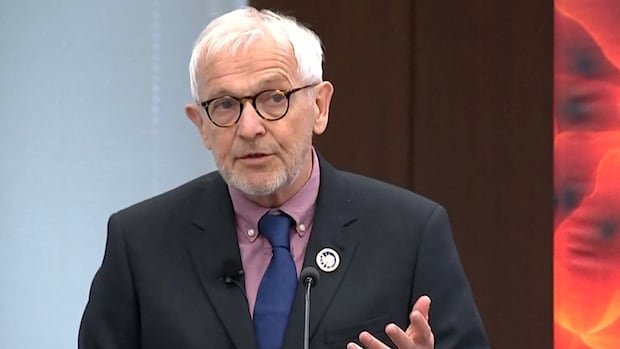

Belgian-American physicist Francis Halzen, aged 82, was named the recipient of the 2026 Nobel Prize in Physics in Stockholm on Tuesday. The award was given in recognition of his significant contributions to the IceCube Neutrino Observatory and the identification of high-energy neutrinos originating from space. Situated at the Amundsen–Scott South Pole Station in Antarctica, the observatory was instrumental in Halzen’s realization that ice at the South Pole could serve as a medium for tracking neutrinos, elusive particles known for their ability to traverse the Earth and matter without leaving a trace.
Eva Olsson from the Royal Swedish Academy of Sciences described the neutrinos as messengers from the universe, providing insights into distant galaxies and the processes of celestial bodies. The Nobel Physics Prize, which amounts to 12 million Swedish crowns (approximately $1.7 million Cdn), is awarded annually by the Royal Swedish Academy of Sciences.
The IceCube Observatory, covering a cubic kilometer, commenced operations in 2011 after years of planning that began in the late 1980s. Halzen expressed gratitude for the collaboration and acknowledged the skepticism surrounding the project’s success in its early stages.
Known as “Neutrino Man,” Halzen’s work focuses on studying neutrinos, enigmatic cosmic particles that offer clues to the universe’s evolution. The IceCube-Gen2 extension, slated to cover eight cubic kilometers of ice and set to launch in 2033, aims to enhance neutrino detection capabilities significantly.
Prime Minister Bart De Wever of Belgium lauded Halzen for his dedication to unraveling cosmic mysteries through his research. The Nobel Prizes, established by Alfred Nobel, are awarded annually to individuals who have made exceptional contributions to humanity. The laureates receive their awards on December 10, the anniversary of Nobel’s death.