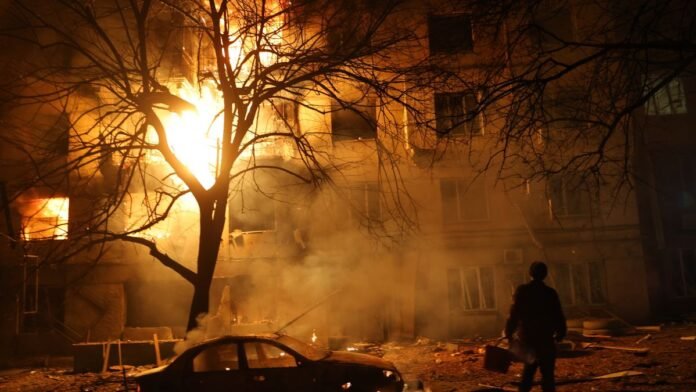

Kremlin forces intensified their assaults on Ukraine shortly after Kyiv embraced significant European alterations to the contentious 28-point US peace proposal. During the night, missiles struck numerous residential buildings, causing fires and injuring at least 19 civilians in retaliatory strikes.
The attacks targeted the Zaporizhzhia region following Ukrainian President Volodymyr Zelensky’s confirmation of substantial adjustments to the pro-Kremlin peace recommendations. The original 28-point plan, attributed to President Donald Trump and suspected to be influenced by the Kremlin, prohibited Ukraine from NATO membership, surrendered territory to Russia, capped Ukraine’s troop strength at 600,000, and would have yielded more land to Russia than it currently holds, while also prohibiting Ukraine from joining NATO.
However, after revisions, a new agreement is believed to remove restrictions on Kyiv’s military size, advocate for a ceasefire prior to a final peace agreement, refrain from territorial concessions, and move towards a feasible peace process, as stated by Zelensky. The plan now integrates numerous favorable elements conducive to ending the conflict.
Additionally, revelations surfaced regarding President Trump’s chief negotiator advising a Vladimir Putin aide on how to present the pro-Kremlin plan. This disclosure shed light on Trump’s inconsistent stance on supporting Ukraine and his seemingly favorable disposition towards Putin’s military objectives.
The negotiator, Steve Witkoff, suggested coordinating a call between Trump and Putin, praising Trump for the Gaza peace deal, and emphasizing shared peace initiatives. Witkoff also proposed a Trump-Putin call before Zelenskyy’s White House visit, prompting Putin to acknowledge Trump’s peace-oriented approach.
Furthermore, it was disclosed that Witkoff will meet with Putin to refine the peace plan, prompting concerns from Rep. Don Bacon about Witkoff’s pro-Russian leanings and his suitability for leading negotiations.
The original peace proposal, which was recently made public, appeared biased towards Russian demands, including the transfer of the entire Donbas region from Ukraine to Russia and a clause preventing Ukraine from NATO membership.
In response to the developments, White House communications director Steven Cheung affirmed Witkoff’s daily engagement with officials from Russia and Ukraine to advance peace efforts, emphasizing Trump’s directive. Secretary of State Marco Rubio maintained that the proposal was drafted by the US with inputs from Russia and Ukraine.