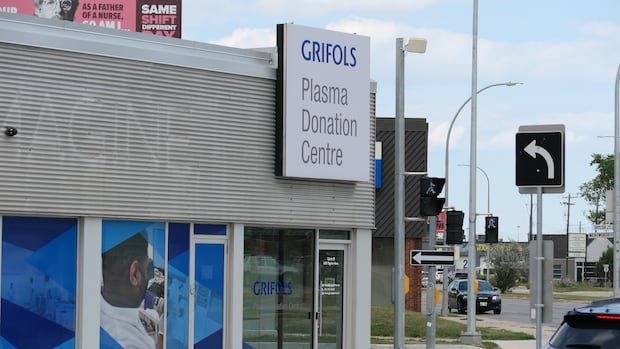

A company specializing in for-profit plasma donations has announced a temporary halt to operations at its Canadian facilities in response to public scrutiny. Grifols stated that it is suspending activities due to unwarranted attention on paid plasma collection and is prepared to resume operations once feasible, in coordination with Health Canada and the Canadian Blood Services. The pause is set to begin on Friday, according to a statement issued by the multinational corporation on Thursday.
Grifols informed Health Canada of its decision on Wednesday, the same day the federal agency issued a non-compliance rating to one of its Winnipeg locations on Taylor Avenue, as outlined in an inspection report summary available on Health Canada’s website. The report highlighted deficiencies in corrective actions, adherence to operating procedures, and staff qualifications documentation at the Winnipeg clinic.
Advocates have been urging the federal government to take action against the company following reports of two individuals dying after donating plasma at different Grifols clinics in Winnipeg. A recent Health Canada inspection, made public through access to information laws, revealed multiple issues related to donor screening and supervision, with six serious adverse reactions reported at Grifols-operated centers since 2018.
Noah Schulz, the provincial director of the Manitoba Health Coalition, emphasized concerns about poor practices at Grifols due to its profit-driven model. Schulz and other advocacy groups have called for a ban on paid plasma donations, citing the company’s cost-cutting practices highlighted in Health Canada inspection reports.
Grifols has reiterated its commitment to donor safety and the quality of collected plasma, stating that these aspects have never been compromised. Public records show that Grifols’ clinics in various Canadian provinces have received non-compliant ratings, with the most recent inspection at the Taylor Avenue location in Winnipeg identifying issues in donor screening, equipment maintenance, and incident investigation procedures.
The temporary closure of Grifols’ plasma collection sites in Canada was welcomed by Katherine Lanteigne, an advocate representing the family of a deceased international student who had donated plasma at the Winnipeg clinic. Health Canada has been working closely with the company to address deficiencies, imposing additional measures, including revised licensing terms, unannounced inspections, and warnings of potential operational suspensions if identified problems persist.
Grifols emphasized that the pause in operations will facilitate collaboration with the government and Canadian Blood Services to establish a plasma collection network with reduced reliance on imported products. Despite the temporary closure, the company, headquartered in Spain, operates approximately 400 plasma collection centers worldwide.