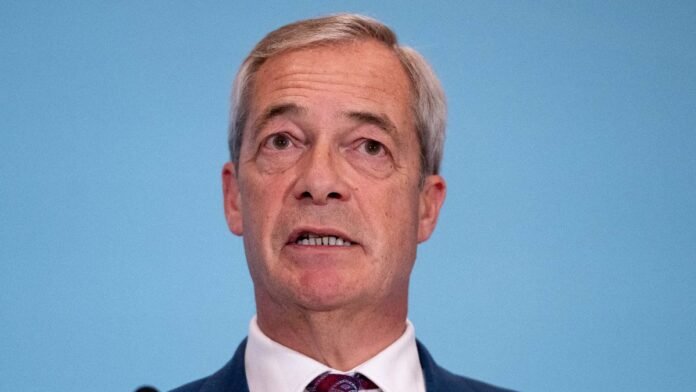

British politics is experiencing a shakeup with a dynamic leader at the forefront of a rising party making significant gains in the polls.
This new political force is challenging the traditional landscape, distancing itself from both Labour and the Conservatives. This scenario echoes back to 1981 when the Social Democratic Party, led by Roy Jenkins and Shirley Williams, promised to revolutionize politics but eventually faced a downfall seven years later.
Nigel Farage, the key figure in Reform UK, has reasons to be cautious as history might repeat itself, with the party’s victory in a General Election not guaranteed until at least 2029.
Recent polls show Reform UK leading at 25%, closely followed by the Conservatives at 22%, the Greens at 19%, Labour at 18%, and the Lib Dems at 10%. These numbers, along with potential anti-Farage strategic voting, could impede Farage’s path to becoming Prime Minister.
Despite its current position as the frontrunner, Reform UK is facing challenges such as controversies surrounding Farage and the party’s members. The party’s vulnerability to scrutiny and accountability in an era of heightened political awareness poses a significant risk.
While Reform UK is anticipated to perform well in upcoming elections in Wales, Scotland, and parts of England, there is a sense of deflation within the party, hinting at a decline in its momentum. While ruling out Farage entirely would be premature, the likelihood of him becoming Prime Minister seems doubtful as public perception evolves.
In conclusion, the public sentiment suggests a growing skepticism towards Farage and his party, indicating a potential shift in political dynamics.