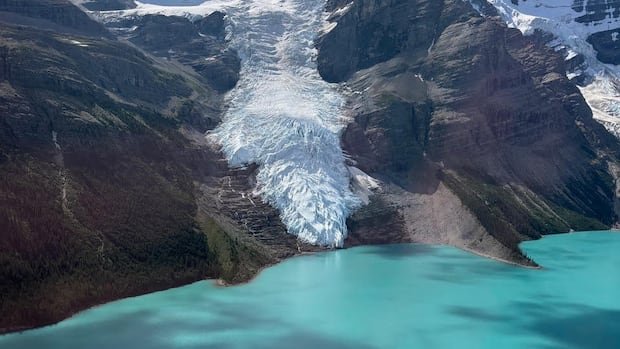

A renowned sight in British Columbia is undergoing a transformation as researchers have discovered that Mount Robson’s Berg Glacier has receded to the point where it no longer reaches Berg Lake.
Joseph Shea, a geography associate professor at the University of Northern British Columbia (UNBC), observed the glacier’s separation from the lake during a field project on the mountain this summer and captured a photo of the phenomenon. Describing it as a significant change, Shea emphasized the visible impact of glacier alterations in the mountainous region.
Situated on the north face of Mount Robson, the highest peak in the Canadian Rockies near the Alberta border in central B.C., the Berg Glacier historically extended to Berg Lake, releasing ice chunks into the lake. The lake derived its name from the icebergs that could be seen floating on its turquoise waters, even in the peak of summer.
Popular among outdoor enthusiasts, the area encompassing the 23-kilometer Berg Lake Trail experiences high demand, with camping spots quickly selling out for the entire summer once reservations open in spring.
Although the separation between the glacier and the lake is not expected to impact the lake’s water levels, it may reduce the direct release of icebergs into Berg Lake. Despite this change, the beauty of Mount Robson remains a compelling destination, preserving the visitor experience albeit serving as a poignant visual representation of climate change.
Research by UNBC scientist Brian Menounos revealed that glaciers in Western Canada and Switzerland lost approximately 22% of their surface area between 1985 and 2021. Climate change-induced events, such as rapid snow and ice melting, led to severe damage to parts of the Berg Lake Trail during a record-breaking heatwave in 2021, necessitating the evacuation of hikers.
Following extensive repair work, the full trail reopened in June 2025. Efforts are underway to install real-time weather stations in collaboration with B.C. Parks to gather crucial data on snowpack, temperature, humidity, wind speed, atmospheric pressure, and precipitation. This initiative aims to support park management, wildfire forecasting, and avalanche prediction, enhancing visitor safety and operational decision-making within Mount Robson Provincial Park.