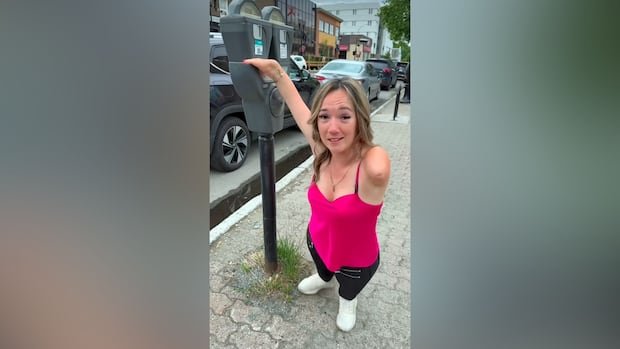

When Charlie Rousseau returned to her hometown of Rouyn-Noranda, Quebec for a festival in June, she encountered traditional parking meters that required users to insert coins. However, due to her limb differences affecting her arms, legs, and hand, Rousseau faced challenges in handling coins and reaching the slot. Despite knowing that several municipalities in Quebec, such as Quebec City and Trois-Rivières, offer free parking to individuals with accessible permits, she decided to take the risk.
Upon her return, Rousseau found a $40 parking ticket on her car, which is specially adapted for her. Prompted by the incident, the social media influencer filmed a video showcasing the difficulty she faced in using the parking meters. Rousseau, who frequently uses her platform to raise awareness about disabilities, expressed her intention to contest the ticket at the city hall.
The video, posted on June 20, garnered over 730,000 views and numerous comments. Rousseau was surprised by the impact it had, as it resonated not only with disabled individuals but also with non-disabled viewers who hadn’t considered such challenges. She emphasized her determination to fight the fine on principle and advocate for accessibility rights in her region and beyond.
Following the viral video, Rouyn-Noranda Mayor Gilles Chapadeau reached out to Rousseau, and they met at city hall. While decisions on parking policies lie with the city council, Chapadeau assured Rousseau that he would use his influence to address the issue. He acknowledged a previous unsuccessful proposal for free parking for accessibility permit holders in 2013.
In response to Rousseau’s advocacy, Steven Laperrière, the executive director of the provincewide advocacy group Regroupement des activistes pour l’inclusion au Québec (RAPLIQ), praised her efforts in highlighting accessibility challenges. Laperrière emphasized the importance of ensuring that all municipal infrastructure is inherently accessible, rather than simply offering free parking. He stressed the need for ongoing consultation with the disabled community to prevent exclusionary practices in the deployment of new technologies and infrastructure.
Despite not claiming to be an official spokesperson, Rousseau, a 29-year-old resident of Laurentians, has emerged as a prominent advocate for disability rights through her social media presence. She views her platform as a means to push for systemic change and increase awareness about the importance of independent mobility in an inclusive society. Rousseau remains committed to leveraging her experiences and voice to drive positive transformations in societal attitudes towards disabilities.