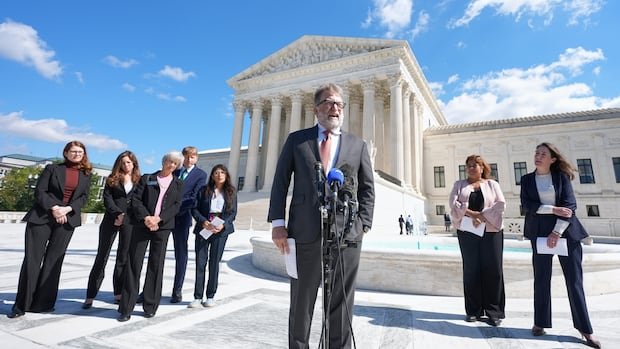

The U.S. Supreme Court faced a significant challenge on Monday concerning whether local governments can bring lawsuits against oil and gas companies in state courts to help offset expenses related to climate change, a matter with potentially immense financial implications. Key justices displayed caution regarding the broad scope of potential litigation, yet grappled with the intricate legal aspects raised by the case.
Officials in Boulder, Colorado, assert that their lawsuit aims to hold Suncor, a Canada-based company, and ExxonMobil, a U.S.-based company, responsible for their roles in climate change. They argue that the increasing frequency of disasters such as floods and wildfires imposes a substantial financial burden on local communities, and the industry should share in these costs.
Both the city and county of Boulder initiated legal action against the oil companies in 2018, well before the devastating 2021 Marshall Fire that razed nearly 1,100 homes and claimed two lives, resulting in an estimated $2 billion in damages—the most expensive wildfire in Colorado’s history. The energy companies contend that a surge of state court lawsuits is not the appropriate method to address the global issue.
Numerous governments from predominantly liberal-leaning regions across the U.S. have lodged similar lawsuits seeking damages that could amount to billions of dollars, aligning with a global trend of legal undertakings to prompt action via the judicial system. Chief Justice John Roberts expressed concerns over the potential aftermath should Boulder emerge victorious, foreseeing a flood of lawsuits from municipalities nationwide.
Justice Brett Kavanaugh warned that a ruling favoring Boulder could financially cripple not only the oil companies but also other potential defendants, suggesting that any entity could be a target in such lawsuits. Conversely, a favorable outcome for the oil and gas companies at the U.S. Supreme Court could halt numerous similar cases initiated in recent years.
Suncor and Exxon argue that the Clean Air Act assigns regulatory authority over emissions to the federal government, not individual states. They enjoy support from the Trump administration, which asserts that the lawsuits represent an unconstitutional bid to regulate emissions causing climate change and extend the reach of Colorado’s state laws beyond its borders.
The court is deliberating a jurisdictional issue that might offer an alternative route to defer immediate decisions on the matter. Justice Ketanji Brown Jackson hinted at supporting this approach, suggesting a wait-and-see stance until state courts conclude their proceedings.
Justice Samuel Alito’s absence, due to ethical recusal just before the arguments, raises the prospect of a tied vote, which would uphold a previous ruling by Colorado’s highest court permitting the case to proceed. The attorney representing the industry urged the justices to reverse this decision, emphasizing that the lawsuit attempts to address a public policy matter that falls within the purview of the U.S. Congress and elected officials.
Principal Deputy Solicitor General Sarah Harris contended that Boulder’s lawsuit exceeds the state’s authority, portraying the county as a victim of actions primarily occurring outside its jurisdiction. However, Kevin Russell, representing Boulder, argued that state lawsuits can address damages within Colorado, irrespective of where the fossil fuels were extracted.
Boulder’s objective, according to Russell, is not to regulate greenhouse gas emissions or halt oil and gas production but to hold the companies accountable for allegedly deceiving the public about their role in exacerbating global warming through fossil fuel combustion.
Justice Elena Kagan drew parallels between the climate case and previous state lawsuits against the tobacco and opioid industries, labeling this as the third chapter in a series where states allege harms stemming from products manufactured nationally and internationally. The industry’s legal representative, Shanmugam, countered that the harms claimed by Boulder have widespread, even global implications.
The Trump administration’s rollback of environmental regulations, including recent moves to repeal emissions limits for coal and natural gas-powered plants, has triggered legal action from states and cities. The conservative-leaning U.S. Supreme Court has historically exhibited skepticism towards environmental regulations, exemplified by a 2022 ruling restricting the EPA’s authority over carbon dioxide emissions from power plants.
A verdict on the case is anticipated in the forthcoming months, with Reuters projecting a release by the end of June.