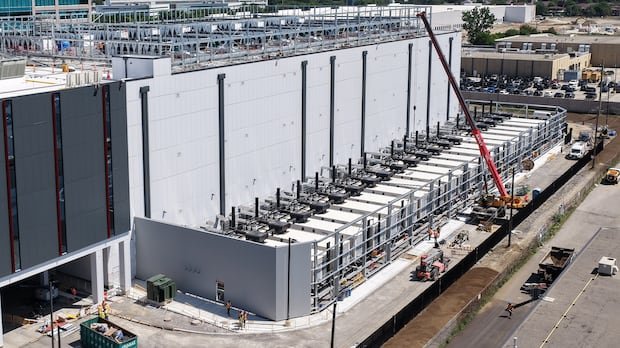

Oakville has implemented a one-year ban on new data centers, marking the first move of its kind in Ontario as local authorities address concerns surrounding the emerging trend of facilities supporting artificial intelligence.
In addition to the moratorium, council members have tasked staff with evaluating whether the town’s existing regulations need revisions to address potential issues related to noise, vibration, emissions, and broader land-use considerations stemming from data centers.
Mayor Rob Burton emphasized that the decision was not made out of fear or in response to any specific application but as a proactive measure to stay vigilant and take necessary actions.
The pause in Oakville comes as neighboring Mississauga prepares to vote on its own halt, while other municipalities in Ontario explore ways to regulate the development of such facilities.
Although there are currently no formal data center proposals in Oakville, Hive Digital Technologies announced plans for a 320-megawatt AI facility in the Greater Toronto Area scheduled for the latter half of 2027, with records showing a Hive subsidiary acquiring property in Oakville shortly before the announcement.
Coun. Tom Adams, representing the area where the property is situated, supported Oakville’s moratorium, describing the town’s study on data centers as essential for comprehensively understanding the impacts on various infrastructures and the well-being of residents.
In response, a spokesperson for Hive stated that while they did not specifically address the moratorium, they respected Oakville’s initiative to establish a planning framework for data center development and affirmed their commitment to transparency and community trust.
The surge in demand for data centers, driven by competition among major tech companies like OpenAI, Anthropic, Microsoft, and Google, has led to the proliferation of these energy-intensive facilities in Canada, with Meta announcing plans for a one-gigawatt data center in Alberta powered by a new gas plant.
Several municipalities, including Hamilton and Waterloo Region, are also exploring measures to regulate data center developments, with some proposing moratoriums and others directing staff to assess and manage these projects within a structured framework.
As the trend continues to unfold, the landscape of data center regulation in Ontario and across Canada is evolving, with local governments striving to balance technological advancement with environmental and community considerations.