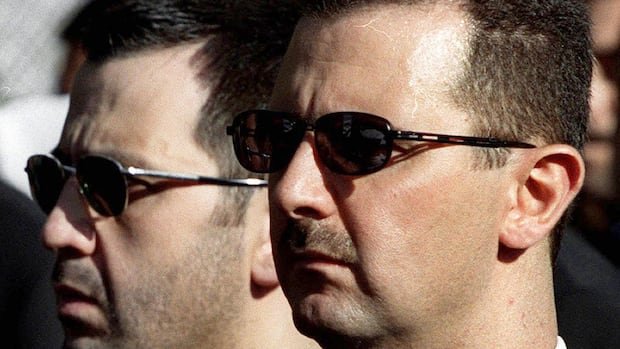

Syria’s Fourth Criminal Court in Damascus has handed down death sentences in absentia to Bashar Assad, the ousted Syrian President, and his younger brother for their involvement in crimes against humanity and war crimes during the 14-year conflict that claimed around half a million lives. This marks the first legal action against Assad or his close associates following the end of their five-decade rule 20 months ago.
Judge Fakhareddine al-Aryan, presiding over the court session broadcast live on state television, stated that Bashar Assad utilized state entities to perpetrate war crimes and crimes against humanity. Atef Najib, Assad’s maternal cousin, was also sentenced to death in connection with overseeing a crackdown in Daraa province that sparked an uprising and eventually led to the civil war.
Under tight security, Najib appeared in court dressed in a prisoner’s uniform inside a cage as the verdict was delivered. A crowd gathered outside the courthouse in central Damascus to hear the outcome. Assad and his brother Maher sought refuge in Russia following the collapse of their regime in December 2024 and have been granted political asylum. The new Syrian authorities have requested Russia to extradite the Assads.
Atef Najib, a former Syrian army brigadier general, sanctioned by the U.S. Treasury Department in April 2011, was detained later and is among the senior officials facing trial. He previously served as head of the political security branch in Daraa province under Assad in 2011.
During Najib’s tenure, a group of teenagers who were detained and tortured after painting anti-government slogans on a school wall in Daraa triggered widespread protests against Assad’s oppressive regime. These protests escalated into a 14-year civil war that culminated in Assad’s removal during a rapid rebel offensive.
The presence of some of Najib’s victims, including individuals who were teenagers in 2011, was noted at the courthouse. Mouawiya Sayasneh and Nayef Abazeid, who were affected by the crackdown, expressed their satisfaction with the sentence handed to Najib and called for justice to be served against Bashar Assad as well.
The scenes outside the courthouse were described as reflecting years of suffering and a long overdue sense of justice. Human Rights Watch, while opposing the death penalty in all cases, emphasized the importance of ensuring a fair trial process for Najib’s appeal. Building a lasting justice system in Syria is deemed crucial for holding accountable those responsible for crimes committed during the Assad era.