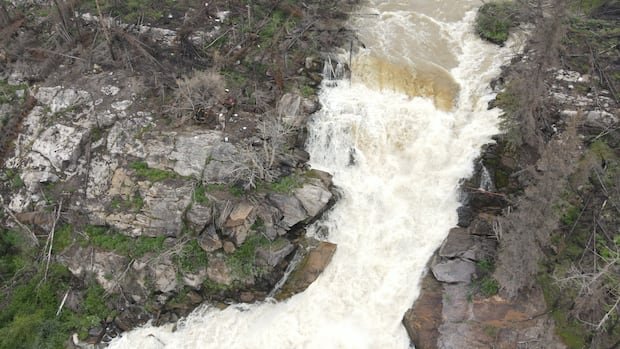

Two scientists have conducted a new assessment of a secluded waterfall, indicating that the rarely explored falls in the rugged boreal shield of northern Manitoba could be the tallest in the province. Alexander Martin and Lukas Olson utilized digital photogrammetry to measure Kapakaytay Falls on the Odei River. Their initial findings suggest a height of 16 meters, slightly surpassing the 14-meter Kwasitchewan Falls near Thompson, which is commonly regarded as Manitoba’s highest waterfall. Olson, a PhD candidate at the University of British Columbia specializing in photogrammetry, expressed confidence in this measurement, with a margin of error of plus or minus one meter.
Although Kapakaytay Falls was previously measured by the government decades ago and listed as 58 feet on topographical maps, this information was not widely disseminated. Martin, a Winnipeg resident and ecology PhD student at the University of Oxford, noted their interest in determining if this waterfall holds the title of Manitoba’s tallest due to the lack of definitive height data. Located approximately 40 kilometers northwest of Thompson and 690 kilometers north of Winnipeg, the falls are situated on the challenging Odei River, making them quite inaccessible.
Olson and Martin embarked on a paddling expedition in July, a journey that demanded meticulous planning, whitewater expertise, and wilderness experience. Navigating through wildfire-affected forests and treacherous river conditions, the duo encountered rapids and logjams along the way. With the assistance of local guides from the Thompson area, they completed a 105-kilometer round trip to reach the waterfall site. Upon catching their first glimpse of the falls after days of paddling, Martin and Olson were captivated by its massive size and the spectacle of water cascading over rocks.
Their research was inspired by a previous expedition led by Winnipeg’s Garrett Fache in June 2019, who believed that Kapakaytay Falls could potentially surpass Kwasitchewan Falls in height. Using over 1,000 two-dimensional images captured by a drone, Olson and Martin engaged in digital photogrammetry to reconstruct and measure the waterfall accurately. They also conducted laser measurements of surrounding trees and natural elements to enhance their model accuracy. The researchers’ preliminary assessment estimates Kapakaytay Falls at around 16 meters, a significant finding that adds to the ongoing exploration and documentation of this remote waterfall site.
As they work towards publishing their research, Olson and Martin hope that their documentation will contribute to future studies of the falls. Despite the province’s assertion that Kwasitchewan Falls remains the tallest based on existing data, the height of Kapakaytay Falls has not been conclusively captured in provincial records. The researchers remain enthusiastic about the potential for further exploration and documentation in uncharted territories, emphasizing the continued opportunities for discovery and research in seemingly mapped regions.