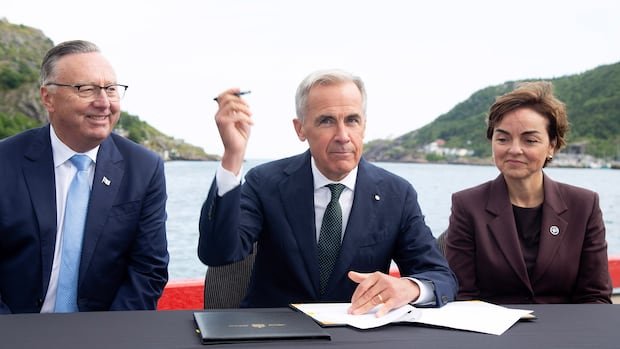

Newfoundland and Labrador Premier Tony Wakeham has decided to forego a public referendum on a new Churchill Falls deal, citing changing political circumstances. Previously, during the provincial election campaign last year, Wakeham had promised a referendum on any Churchill Falls deal. However, alongside Prime Minister Mark Carney and Quebec Premier Christine Fréchette, a new deal was announced on Monday without a referendum, leading to disappointment among the public.
In a phone interview with CBC Radio’s The St. John’s Morning Show, Wakeham explained that the involvement of the federal government in the new deal presented a significant opportunity that was not previously considered. He emphasized that the current geopolitical landscape, including the U.S. trade war and the recent pause on Canadian tariffs by President Donald Trump, influenced the decision to proceed without a referendum.
The House of Assembly will convene on September 14 for a special debate on the new agreement. Wakeham highlighted that the new deal supersedes a 2024 Memorandum of Understanding (MOU) reached by the previous Liberal government, which was deemed unfavorable for the province following a review commissioned by Wakeham’s administration.
Key features of the new agreement include the option for Newfoundland and Labrador to sell power to Quebec or retain excess power for local industries. Additionally, the federal government’s involvement brings benefits such as loan guarantees for the Gull Island hydroelectric project, investment tax credits, and assistance in constructing the Labrador Transmission Line.
Addressing concerns about potential opposition to the deal, Wakeham expressed confidence that the current agreement is superior to the previous one and provides more benefits, including increased power capacity and transmission capabilities. He also mentioned the possibility of a Quebec election affecting the deal but stressed that it is mutually beneficial for both provinces.
Energy N.L. CEO Charlene Johnson expressed optimism about the new energy projects, emphasizing the economic opportunities they will bring, from engineering to operation and maintenance. Johnson echoed Carney’s statement that the deal represents a significant clean energy investment in North American history, underscoring Newfoundland and Labrador’s capacity to meet global energy demands.
Looking ahead, Wakeham aims to finalize the agreement by the end of the year, as stakeholders prepare for the potential economic growth and development opportunities stemming from the new Churchill Falls deal.