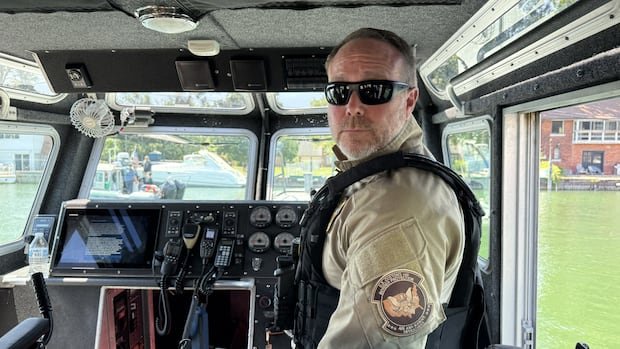

Tim Thayer, equipped in a black bulletproof vest and with a gun holstered to his side, smoothly triggers the engines of a U.S. Customs and Border Protection boat with four 350-horsepower engines on the Detroit River. Thayer, a marine interdiction agent, is part of a team that monitors the waterways along the Canada-U.S. border in this region. Specifically assigned to the Detroit sector covering Michigan, Ohio, Indiana, and Illinois, Thayer faces the unique challenge of safeguarding the entire 1,388-kilometer water border between the two countries.
The area’s geography presents an interesting dynamic as Windsor, Ontario, lies to the south of Detroit, with the river serving as the boundary and connected by bridges and a tunnel. Approximately seven million individuals cross this border annually. On a sunny Wednesday afternoon, Thayer scans the Windsor shoreline, vigilantly watching for any unusual activities.
Thayer mentions that their patrols often encounter people, drugs, and firearms being transported between the U.S. and Canada on the Detroit River. While the region was a prominent route for smugglers during the Prohibition era, present-day illegal activities on the Detroit River are not as prevalent. However, the high number of recreational boaters poses a challenge for law enforcement efforts.
According to Kris Grogan, the chief of external communications at CBP’s air and marine operations, the multitude of boats on the river presents a challenge as each one could potentially be involved in smuggling activities. Hence, intelligence gathering and partnerships are essential in securing the area effectively.
In 2025, U.S. President Donald Trump accused Canada of failing to prevent drug trafficking, particularly of substances like fentanyl and human traffickers, prompting him to impose tariffs on Canadian goods. However, the U.S. Supreme Court later overturned these tariffs. Despite Trump’s portrayal of a porous border, the reality is more complex.
In the Detroit sector in 2025, U.S. border officials seized over 4,200 kilograms of illegal drugs, including nearly 15 kilograms of fentanyl. Notably, most recovered firearms in Ontario crimes were traced back to the U.S., indicating a significant flow of weapons northward.
While drugs and weapons primarily move from the U.S. to Canada, there is still concern about Canada’s border security. Experts emphasize the need for enhanced staffing, training, and equipment to address these challenges effectively.
The U.S. border agents underscored the continued strong partnership with their Canadian counterparts despite ongoing political tensions. The scene on the Detroit River reflects the nuanced relationship between the two countries, symbolized by the presence of the Gordie Howe bridge in the distance.