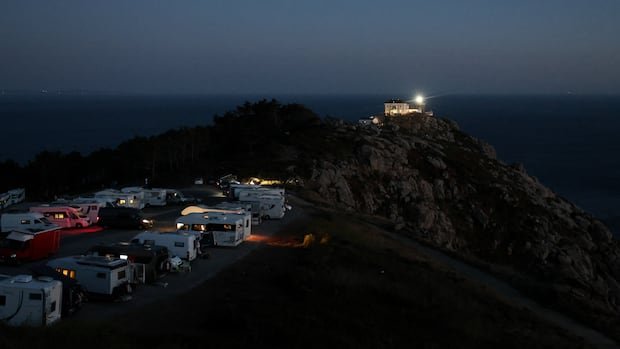

Hundreds of thousands of visitors have flocked to Spain to witness the solar eclipse happening on Wednesday. However, with the country facing high temperatures and an increased risk of wildfires, authorities are on high alert to prevent any potential fire damage caused by the surge in astrotourism.
Virginia Barcones, the secretary general for civil protection and emergencies at Spain’s Interior Ministry, expressed concerns about the current wildfire situation in Spain, emphasizing the need to limit activities that could trigger fires. Spain has been battling a severe wildfire season, with over 603,000 acres of land scorched in approximately 400 fires this year, as reported by the European Forest Fire Information System.
To mitigate the risk of additional fires during the eclipse event, authorities are deploying 35,000 officers to monitor large outdoor gatherings and swiftly address any fire incidents, Barcones stated. Spain is a prime location for viewing the solar eclipse, with the path of totality stretching across northern Russia, eastern Greenland, western Iceland, and parts of Spain, including the Balearic Islands.
Only regions within the path of totality will witness the complete coverage of the sun by the moon. As anticipation grows for this rare celestial event, authorities are reminding the public, especially in regions like Canada where a partial eclipse will be visible, to use proper eye protection such as eclipse glasses.
The upcoming solar eclipse marks the first time in 120 years that mainland Spain will experience a full solar eclipse, attracting a significant influx of travelers. Special measures have been put in place to accommodate the large crowds expected to gather along the eclipse’s path, with a notable rise in searches for accommodations in Valencia, Spain, reported by Expedia Group.
With an estimated 440,000 people anticipated to visit official viewing sites during the eclipse, authorities are preparing for a potential total of 1.5 million individuals on the roads, emphasizing caution to prevent wildfires. The economic impact study by the Ministry of Economy, Trade and Business projects that the eclipse event could contribute over 347 million euros to Spain’s economy.
Despite the challenging conditions posed by the heat wave and wildfire threats, the enthusiasm for the eclipse remains unwavering among travelers. Professor Jan Cami from Western University in London, Ont., highlighted the awe-inspiring nature of the eclipse experience and its potential to foster a deeper appreciation for nature and climate change impacts.
Looking ahead, the 2026 eclipse is the first of a series of solar eclipses visible from Spain, with two more expected in the coming years. The upcoming 2027 eclipse could further boost astrotourism, with the path of totality extending from southern Spain to countries in North Africa, offering unique viewing opportunities for enthusiasts worldwide.