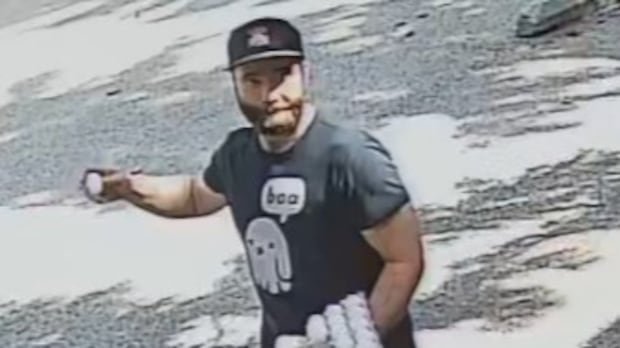

Members of a synagogue in Saskatoon express relief as the individual responsible for vandalizing their place of worship has come forward to the police and is now engaging in talks on how to make amends with the Jewish community.
Mike Scharfstein, co-president of the Congregation Agudas Israel synagogue, shared that while the news that the incident was not a targeted attack brings some reassurance, it is still challenging to fully accept. The accused, Jayden Clarke, aged 31, faces three counts of mischief under $5,000.
Clarke was formally charged following his identification in a police-issued photo captured by a surveillance camera, which showed the suspect throwing eggs at the synagogue and nearby parked vehicles during a morning prayer service on August 1. Clarke voluntarily surrendered at Saskatoon police headquarters on August 13 and was subsequently released with conditions pending a hearing in provincial court on September 16.
According to his lawyer, Brian Pfefferle, Clarke confessed to the act, attributing it to a reckless, alcohol-fueled “juvenile act” rather than any animosity towards the Jewish community. Pfefferle emphasized Clarke’s intention to convey to the synagogue and the broader Jewish community that the incident was not motivated by hate. He also mentioned Clarke’s commitment to addressing the role of alcohol in the incident.
Pfefferle, on Clarke’s behalf, initiated contact with the synagogue’s leadership to explore opportunities for Clarke to make reparations to the congregation. Scharfstein noted that discussions regarding this matter are ongoing.
The synagogue community seeks to understand the motives behind the vandalism and why their place of worship was targeted if the act was not related to their Jewish identity. Scharfstein mentioned the concept of “teshuva,” a form of repentance in Judaism, as a potential avenue for Clarke to seek forgiveness.
While the Saskatoon police’s hate crimes unit was involved in the investigation, they did not find sufficient evidence to pursue hate crime charges. The charges laid against Clarke were based on the available evidence, with the possibility of amendments pending further findings by the prosecution.
The incident goes beyond mere vandalism for the synagogue community, reflecting a broader sense of vulnerability and potential targeting faced by Jewish communities worldwide. Statistics Canada reports that a significant percentage of police-reported hate crimes against religious groups in 2024 were directed at the Jewish community.
Richard Robertson, director of research and advocacy at B’nai Brith of Canada, called for continued investigation into Clarke’s motivations by Saskatoon police. He emphasized the importance of considering any potential hateful intent behind the act of targeting a synagogue.
Robertson acknowledged Clarke’s remorse and desire to make reparations but emphasized that this does not diminish the harm caused by his actions. Ultimately, the decision to accept any reparations rests with the Congregation Agudas Israel congregation.
The community remains vigilant, recognizing the need to address not just the immediate incident but also the underlying issues of vulnerability and security faced by Jewish communities.