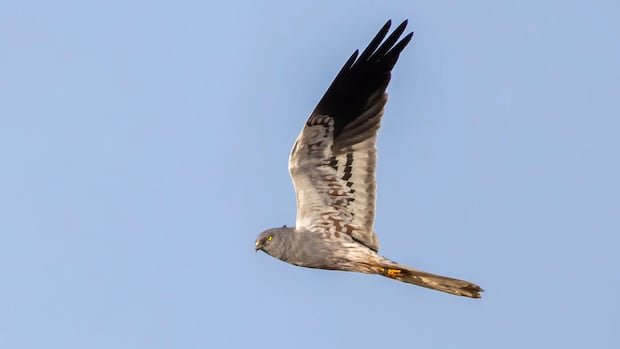

Conservationists in the United Kingdom have been striving to prevent a rare bird species, the Montagu’s harrier, from disappearing entirely. According to conservationist Mark Thomas, recent progress in safeguarding the British population of these birds can be mostly credited to the exceptional breeding abilities of a single male named AU. This 10-year-old male, nicknamed “golden boy” due to his impressive track record, has fathered a total of 16 offspring, with 10 born in the last two years alone.
Thomas, who serves as the species lead for the Royal Society for the Protection of Birds (RSPB), highlighted AU’s crucial role in sustaining the species in the U.K., emphasizing that he is a key figure in the preservation efforts. Montagu’s harriers are migratory birds that winter in Africa and parts of Asia before returning to Europe for breeding each spring. Although the global population of these birds is declining, in the U.K., the RSPB reports a rapid decline in their numbers, posing a threat of extinction in the country.
In the 1950s, there were around 30 breeding pairs of Montagu’s harriers in the U.K., but this number plummeted to zero in the 1970s before gradually increasing to 13 in the mid-2000s. However, between 2000 and 2003, there were no reported breeding pairs, indicating a concerning decline. The recent success in breeding is attributed to AU, who successfully raised four chicks in 2025 and returned this year to continue his mating efforts.
This year, AU attracted the attention of three females, leading to a competitive scenario among the females. Ultimately, two females stayed with AU and nested with him, resulting in six chicks, four females, and two males. Conservationists remain optimistic that AU’s offspring, especially his male progeny from 2025, will return to the U.K. for breeding in the future, thus contributing to the species’ survival.
To protect the newly hatched chicks, conservationists have placed them in two nests located approximately one kilometer apart on a confidential British farm. Only designated individuals are aware of the nest locations, and protective barriers have been set up to shield the chicks from predators and other risks. Additionally, the RSPB has implemented satellite tracking on two juvenile harriers for the first time, enabling researchers to monitor their movements and potential return for breeding, providing valuable insights into the species’ conservation efforts.