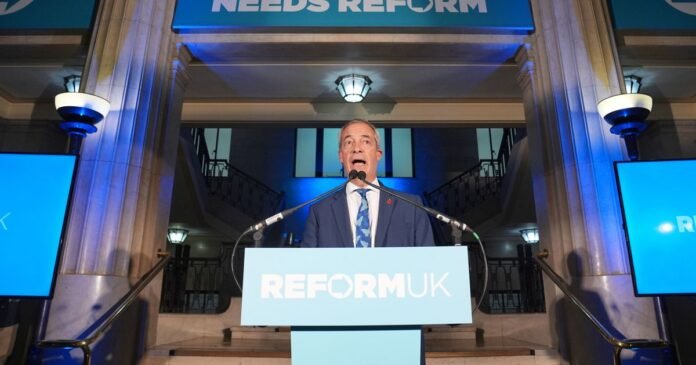

Nigel Farage predicts a financial crisis will trigger a general election in 2027. The Reform leader, aiming to showcase his ability to manage the country’s finances, conceded that committing to significant tax cuts is not feasible. However, he remains steadfast in his proposal to introduce a “golden opportunity for billionaires” if he assumes the role of Prime Minister.
Farage’s proposals were previously criticized by the Institute for Fiscal Studies, a reputable think tank, which stated that the figures in Reform’s manifesto do not align. Additionally, Farage is anticipated to defend the decision to exit the EU, countering Rachel Reeves’ assertion that Brexit is responsible for the UK’s economic condition.
During a recent speech, Farage declined to disclose his choice for Chancellor. While denying Reform is a one-person operation, he acknowledged that the party is not yet prepared to reveal key personnel appointments. He emphasized that the selection process for roles such as Chancellor and Home Secretary is ongoing.
Addressing the audience, Farage acknowledged the impracticality of significant tax reductions given the country’s financial challenges. He outlined plans for modest tax adjustments, such as eliminating inheritance tax on family farms and businesses and raising tax thresholds to alleviate financial burdens on working individuals.
Farage clarified misconceptions surrounding Reform’s welfare stance following criticism from the Tories. He clarified that Reform aims to remove the two-child cap for British working couples to support families facing financial constraints due to high childcare costs.
Farage reiterated his controversial proposal to offer foreign billionaires a “non-dom” tax status for a £250,000 fee, despite concerns raised by experts about potential revenue losses for the Treasury. He defended his stance, emphasizing the importance of retaining high-earning individuals in the UK to sustain tax revenue for the benefit of society.
Acknowledging the significance of the financial services sector in Britain, Farage praised the industry during his speech. He highlighted concerns about excessive HR and compliance regulations hindering businesses and expressed a desire to reduce regulatory burdens to enhance competitiveness, citing Brexit as a potential solution.
Farage expressed disappointment over the perceived failure to capitalize on Brexit’s benefits, emphasizing the need for deregulation and global competitiveness. He criticized the current regulatory environment as more burdensome than pre-Brexit, lamenting missed opportunities for economic growth.
Foreseeing economic turmoil leading to a general election in 2027, Farage suggested that market pressures could compel the Chancellor to implement austerity measures, triggering political unrest. He criticized the lack of fiscal discipline in budget planning and highlighted widespread pessimism among businesses and savers.
Farage’s comments on taxation, migration, and remote work were met with mixed reactions. Labour criticized Reform UK’s economic strategy, labeling it regressive and likely to result in austerity measures. Farage is expected to advocate for reduced business regulations in his upcoming address, citing Brexit as a potential mechanism for reform.
In summary, Farage’s economic proposals have sparked debate and scrutiny, with varying opinions on their feasibility and potential implications for the UK’s financial landscape.