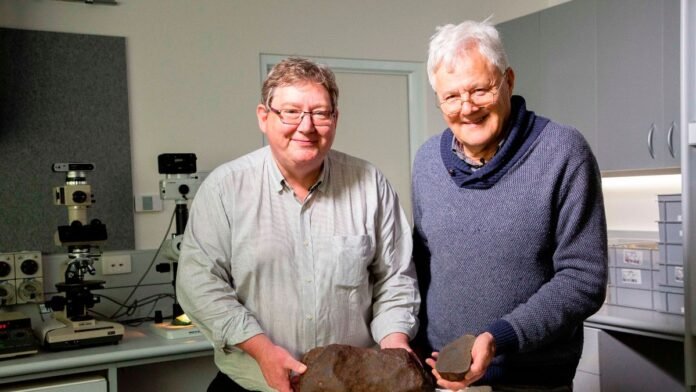

A man exploring Maryborough Regional Park near Melbourne with a metal detector stumbled upon an intriguing discovery that initially seemed like a giant gold nugget. However, the truth turned out to be far more remarkable than expected.
David Hole unearthed an unusually heavy stone in the soft yellow clay of the park, a location known for gold rushes in the 19th Century that transformed Australia. Attempting to confirm if it was gold, David found the rock impervious to various tools like rock saws and acids.
After three years, David took the rock to the Melbourne Museum, where geologists Dermot Henry and Bill Birch identified it as a 4.6 billion-year-old meteorite. Only the 17th meteorite discovered in Victoria, this rare find provided valuable insights into the origins of the Solar System.
Comprised of dense iron and nickel, the meteorite, now dubbed the Maryborough Meteorite, possesses a distinctive weight compared to ordinary rocks. Geologists used specialized equipment to reveal its internal structure, showcasing crystallized metallic minerals known as chondrules.
Originating from the Asteroid Belt, these meteorites offer a glimpse into the formation of the solar system. David’s meteorite likely landed near Maryborough after a journey through space, possibly coinciding with a documented fireball sighting in 1951.
David marveled at his serendipitous find, describing it as an extraordinary event with odds surpassing a trillion to one. The discovery highlighted the significance of meteorites in unraveling the mysteries of our cosmic origins.