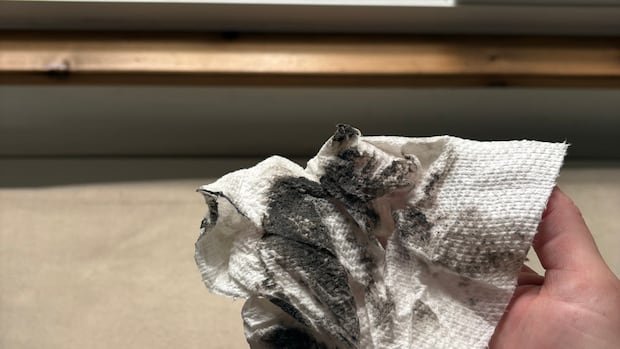

A group of scientists in Hamilton have uncovered details regarding the soot contaminating neighborhoods adjacent to the city’s industrial zone. Residents have long been troubled by a dark, sooty residue coating their properties, with the issue resurfacing in early July as one of the most severe incidents in recent memory. Sarah Styler, an associate professor specializing in environmental chemistry at McMaster University, and Grace Yao, a PhD student under Styler’s supervision, are part of a research project titled “What’s the Grime?” aimed at addressing the source of this problem.
By collaborating with volunteers to gather samples across the city in 2024 and 2025, the researchers identified harmful chemicals in the soot consistent with coal combustion. They observed elevated levels of dust and polycyclic aromatic hydrocarbons (PAHs) in the vicinity of the industrial region in northeast Hamilton. The study, conducted with a $15,000 grant awarded to Styler by the university in 2024, was a joint effort with Environment Hamilton.
Styler, who resides in east Hamilton, and Yao, who lives in Corktown, both have firsthand encounters with the issue. Highlighting the longstanding nature of the problem, Styler mentioned that historical records dating back to the 1950s referenced the soot. The study involved the collection of soot samples from the homes of 50 volunteers, with periodic analysis of the samples conducted by scientists.
Styler emphasized that more dust and toxic compounds are prevalent closer to the industrial sector, indicating a direct correlation. The team’s findings, particularly on PAH levels being higher during winter than summer, were shared in an update on the Environment Hamilton website. While the study focused on 13 different PAHs, Styler cautioned that other toxic substances could also be present in the soot.
The researchers acknowledged limitations in their study due to resource constraints, implying that additional sources may contribute to the fallout. Despite an inability to pinpoint the exact industrial sources generating the PAHs, continuous monitoring and enhanced analytical capabilities could facilitate such identification in the future. Styler highlighted that the findings may not be surprising to residents most affected by the fallout, as the substance likely originates from industrial emissions near coke plants.
Styler’s team plans to present their results at a community meeting on Aug. 20 and is in the process of submitting a manuscript for peer review to share further insights. They aim to expand the study to include 200 volunteers and explore additional compounds within the soot, with a particular interest in effective cleaning methods.