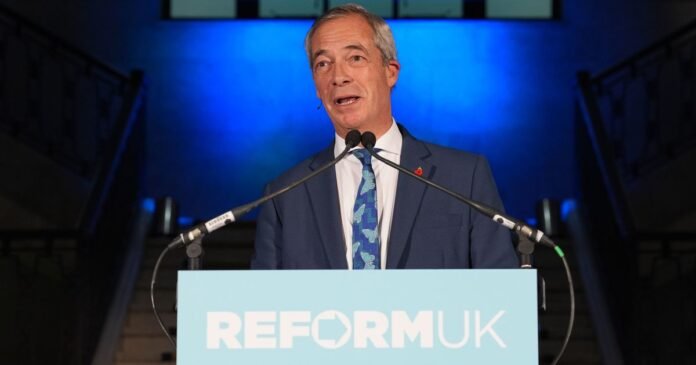

Nigel Farage has been accused of planning to make deeper cuts to public services than the Conservative Party and facing criticism for dismissing pensioners, with Reform being labeled as “vultures” by detractors.
During a speech in the City of London, the leader of Reform UK abandoned tax pledges amounting to billions of pounds but pledged to implement welfare cuts and significantly reduce public spending if his party comes to power. Farage expressed his belief that economic upheaval would lead to a general election in 2027, lamenting missed opportunities post-Brexit.
Farage hesitated to commit to maintaining the pensions triple lock if elected, and proposed reducing the minimum wage for young employees while defending a controversial plan to aid wealthy foreign tycoons in tax avoidance.
Critics accused him of presenting an “incoherent saloon bar budget” that would favor hedge funds and financial speculators over ordinary workers. Responding to queries about the pensions triple lock, Farage suggested the uncertain economic landscape made it challenging to make long-term projections.
Daisy Cooper, the Deputy Leader of the Liberal Democrats, accused Farage of jeopardizing vulnerable pensioners to finance his anti-net zero agenda and secretive advisers, asserting that he would betray them if given the opportunity to govern. She vowed to combat Reform’s policies to safeguard pensioners.
Farage admitted that achieving significant tax reductions might be more difficult than previously claimed, acknowledging the impracticality of substantial tax cuts given the country’s mounting debt and financial constraints. He reiterated his intention to introduce a Britannia Card, requiring wealthy overseas individuals to pay £250,000 to evade taxes on foreign income and inheritance.
Moreover, he hinted at the possibility of reducing the minimum wage for young workers, citing concerns that the current rates might be excessive, especially after lowering the National Insurance Contributions threshold to £5,000 annually.
Reform’s previous manifesto pledged tax cuts equivalent to about a third of the NHS budget, including raising the personal allowance to £20,000 and implementing a £100,000 tax-free allowance for companies, among other measures. However, independent analysis by the Institute for Fiscal Studies raised concerns about the feasibility and cost of Reform’s proposals.
Following Farage’s speech, Paul Nowak, the General Secretary of the TUC, criticized Reform as the party of austerity, accusing Farage of planning even deeper cuts than previous administrations, which would severely impact public services. Nowak warned of potential job losses in crucial sectors due to Reform’s stance on net zero and its implications for workers’ rights and environmental standards.
Labour’s spokesman condemned Farage’s proposed austerity measures, emphasizing the detrimental effects on public services, employment, and infrastructure investments. Farage’s speech highlighted his belief in trickle-down economics, advocating for high earners to stay in the country to contribute to the tax system and alleviate the tax burden on lower-income individuals.
In response, Tory Shadow Chancellor Sir Mel Stride criticized Reform’s economic proposals, labeling them as chaotic and lacking viable solutions for the country’s economy. Stride pointed out the absence of funding for substantial promises and the party’s controversial plan to seize private assets, branding it as disruptive rather than beneficial for Britain’s economic stability.