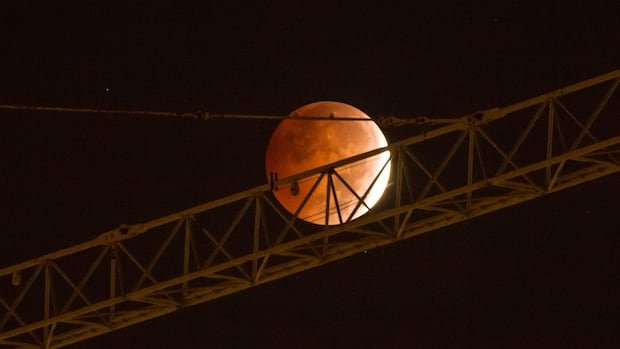

On the night of August 27-28, a deep partial lunar eclipse will be visible nationwide. This event follows the recent total solar eclipse witnessed in Iceland, Spain, and a portion of Portugal. The lunar eclipse will reach 93% coverage at its peak, occurring when the moon passes through Earth’s shadow, known as the umbra, after moving through the penumbra. Most areas in Canada will have a clear view of the eclipse, with Western Canada catching the partial eclipse as the moon rises.
Unlike solar eclipses, no protective eyewear is required to witness the lunar eclipse, which unfolds over several hours. The eclipse will commence as the moon enters Earth’s penumbra around 10 p.m. ET, with the visible phase starting at 10:33 p.m. ET on August 27 and concluding at 1:52 a.m. on August 28. The deepest eclipse moment, with most of the moon in shadow, will happen at 12:13 a.m.
The eclipse will be visible across North and South America, offering a unique celestial event for skywatchers. Elaina Hyde from the Allan I. Carswell Observatory at York University in Toronto mentioned the array of astronomical events in August, including the partial solar eclipse and the Perseids meteor shower. While the lunar eclipse won’t turn entirely red, parts of Canada may witness a reddish hue. Binoculars, a small telescope, or a smartphone with a good night mode can enhance the viewing experience and allow for capturing memorable images.