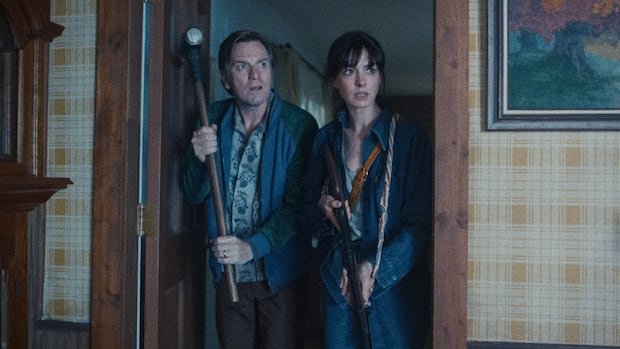

In 1982, as a homemaker, your concerns may revolve around your children’s activities, your spouse’s work choices, or peculiar occurrences like lights and heat anomalies, even a dinosaur-like presence in your backyard. Welcome to Oak Street, a setting where a discontented family navigates their neighborhood’s sudden time shift to the late Jurassic era, facing external challenges alongside internal conflicts.
Portraying a Spielberg-esque narrative with a Stephen King vibe, “The End of Oak Street” introduces the audience to the ordinary yet troubled family of Denise, Greg, Audrey, and Brian in Detroit. This family drama unfolds in a manner reminiscent of classic American households, offering a blend of nostalgia and suspense akin to an Amblin-style production.
While the film promises a thrilling time-traveling dinosaur adventure, it falls short of expectations despite its fun and original moments. Critically acclaimed as a summer blockbuster, “Oak Street” lacks the depth and artistic vision of its predecessors, emulating Spielberg’s style without fully grasping the underlying themes.
The movie’s potential character arcs and themes are overshadowed by the constant dinosaur encounters, leading to a lack of character development and repetitive action sequences. As the family faces the prehistoric challenges, the film struggles to engage viewers beyond the spectacle of dinosaur attacks and chaotic visuals.
Despite its visual appeal, “The End of Oak Street” fails to deliver a compelling narrative, leaving audiences detached from the characters’ struggles. While the film pays homage to cinematic greats, its lack of substance raises questions about its impact and relevance in the realm of storytelling.
In a cinematic landscape saturated with familiar tropes and recycled ideas, “Oak Street” struggles to carve its own identity, relying on spectacle rather than storytelling depth. Whether viewers find solace in its nostalgic nods to past films or crave a more profound narrative remains subjective, highlighting the evolving landscape of modern filmmaking.