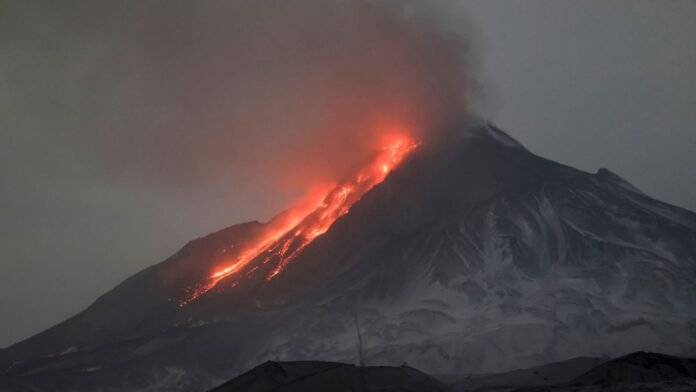

A volcano in Russia’s far east has erupted, sending a dense ash column over three miles into the sky. The ash plume has traveled northeast for about 33.5 miles, causing potential disruptions to air travel in the vicinity. An orange aviation hazard code has been issued following warnings from scientists about a possible explosive eruption.
Bezymianny, once thought extinct after a 1,000-year dormancy, erupted catastrophically in 1955. In a separate incident in April 2023, the Shiveluch volcano in Kamchatka shrouded an area larger than Scotland and Wales combined in darkness as an ash cloud spread for hundreds of miles, reaching heights of 12 miles into the atmosphere. The volcanic activity prompted a red aviation warning due to the significant ash plume.
Alexey Ozerov, director of the Institute of Volcanology and Seismology, described the ash cloud from Shiveluch as extending 500 kilometers northwest and expanding. Residents in the nearby village of Klyuchi reported the morning sky becoming pitch dark, with one resident noting the absence of sunlight.
Danila Chebrov, director of the Kamchatka branch of the Geophysical Survey, stated that the ash reached 20 kilometers in height and heavily impacted nearby villages. Kamchatka, part of the Pacific Ring of Fire, boasts around 160 volcanoes, with 29 currently active.
Known for its high concentration of volcanoes and geological features like geysers and hot springs, Kamchatka is a UNESCO World Heritage Site. Notable volcanoes in the region include Klyuchevskaya Sopka, the tallest active volcano in the Northern Hemisphere, and Mutnovsky, renowned for its active fumaroles.